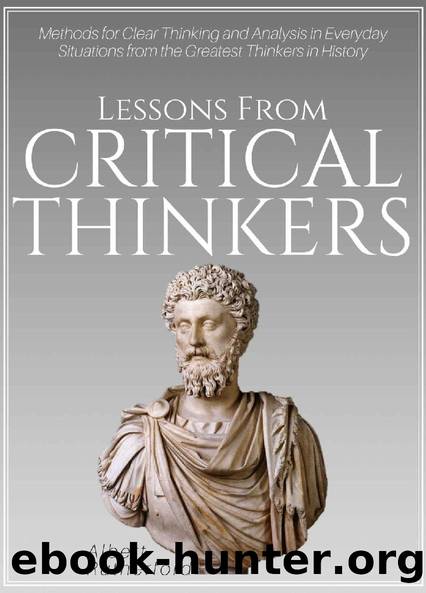
Lessons From Critical Thinkers: Methods for Clear Thinking and Analysis in Everyday Situations from the Greatest Thinkers in History (The critical thinker Book 2) by Albert Rutherford
Author:Albert Rutherford [Rutherford, Albert]
Language: eng
Format: epub
Published: 2018-12-19T00:00:00+00:00
The categorical imperative is the ethical theory that the ethical way to act is the way in which the actor would be happy if everyone were to do the same action. This is, of course, a critically-reasoned theory instead of one derived from observations. This is because Kant positioned his work in direct conversation with that of Scottish empiricist David Hume. Hume's theory of knowledge coming exclusively through sense perception led him to conclude that space and time do not exist, but are invented by the brain to help comprehend reality. Hume also concluded there is no such thing as causality; instead, it is a mental tool we use to help with practical prediction. Hume realized that the mind itself limited critical thinking and human understanding; Kant built on his work by attempting to probe these limits and see what they could do.
Download
This site does not store any files on its server. We only index and link to content provided by other sites. Please contact the content providers to delete copyright contents if any and email us, we'll remove relevant links or contents immediately.
| Anthropology | Archaeology |
| Philosophy | Politics & Government |
| Social Sciences | Sociology |
| Women's Studies |
Cecilia; Or, Memoirs of an Heiress — Volume 1 by Fanny Burney(32558)
The Great Music City by Andrea Baker(32019)
Cecilia; Or, Memoirs of an Heiress — Volume 2 by Fanny Burney(31956)
Cecilia; Or, Memoirs of an Heiress — Volume 3 by Fanny Burney(31942)
We're Going to Need More Wine by Gabrielle Union(19046)
All the Missing Girls by Megan Miranda(16028)
Pimp by Iceberg Slim(14507)
For the Love of Europe by Rick Steves(14121)
Bombshells: Glamour Girls of a Lifetime by Sullivan Steve(14075)
Talking to Strangers by Malcolm Gladwell(13370)
Norse Mythology by Gaiman Neil(13365)
Fifty Shades Freed by E L James(13241)
Mindhunter: Inside the FBI's Elite Serial Crime Unit by John E. Douglas & Mark Olshaker(9343)
Crazy Rich Asians by Kevin Kwan(9292)
The Lost Art of Listening by Michael P. Nichols(7506)
Enlightenment Now: The Case for Reason, Science, Humanism, and Progress by Steven Pinker(7313)
The Four Agreements by Don Miguel Ruiz(6765)
Bad Blood by John Carreyrou(6621)
Weapons of Math Destruction by Cathy O'Neil(6280)
